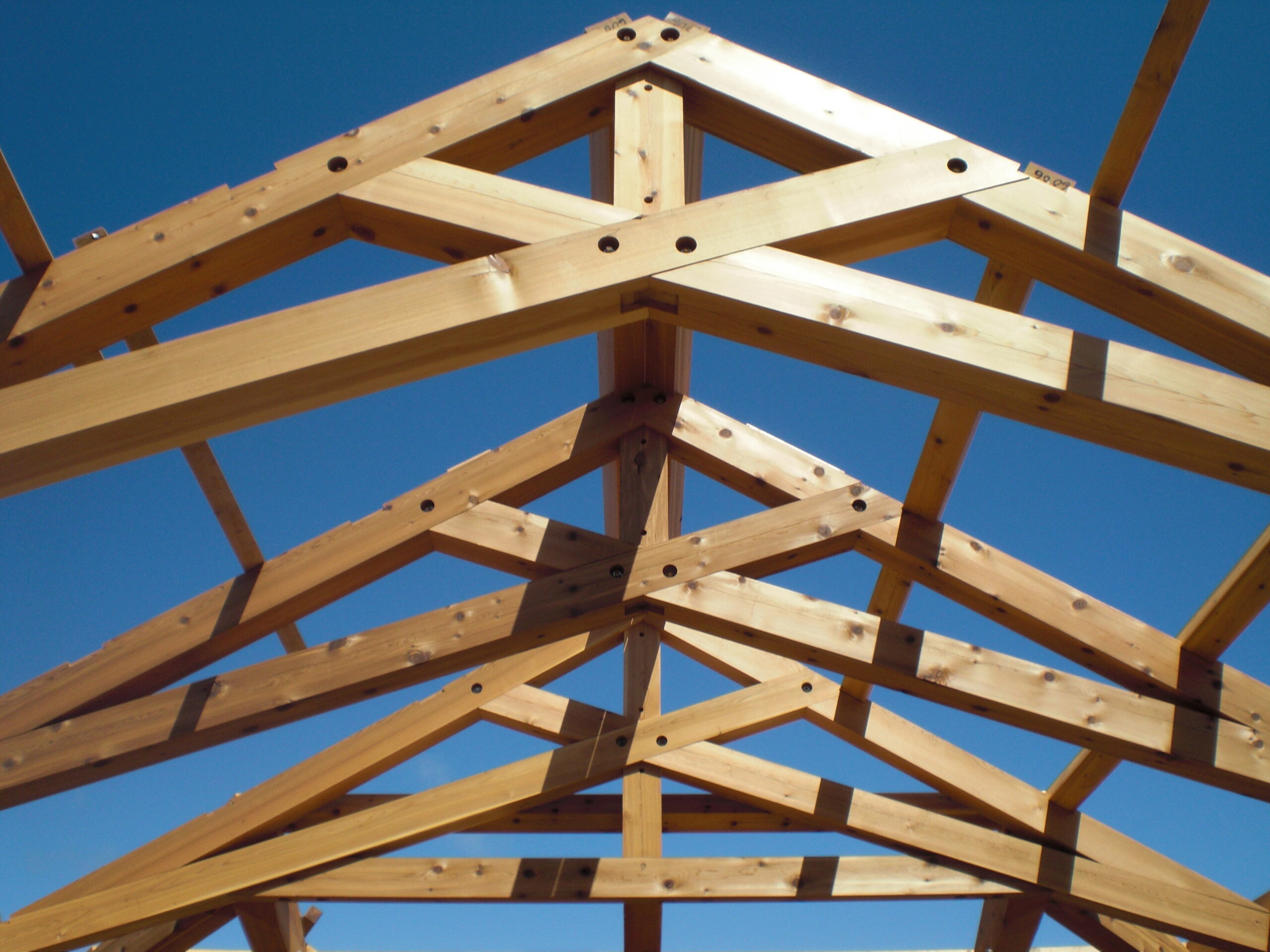
Headlines about tariffs on Canadian lumber have many prospective home builders worried about their budgets, and for good reason: the National Association of Home Builders estimates that recent tariffs and duties have added at least $10,000 to the cost of a new home. If you have been dreaming of a timber frame home, that news can feel discouraging. Here is the reassuring part, and the reason this guide exists: the tariffs making headlines apply to raw and commodity softwood lumber, not to the manufactured timber frame packages that Hamill Creek Timber Homes builds and ships to clients across the United States.
Hamill Creek Timber Homes is a specialist timber frame designer and manufacturer based in Meadow Creek, British Columbia, with more than 35 years of experience shipping custom timber frames across North America. Because Hamill Creek’s products are manufactured, precut timber frame home packages rather than raw lumber, they continue to enter the U.S. tariff-exempt under the Canada-United States-Mexico Agreement (CUSMA). This guide explains what the current tariffs on Canadian lumber actually are, how they affect home building costs, why manufactured timber frame kits are treated differently, and where the trade dispute is headed.
What the Current Tariffs on Canadian Lumber Actually Are
As of mid-2026, most Canadian softwood lumber faces a combined U.S. burden of roughly 34.83%. That figure is made up of two separate measures: preliminary antidumping and countervailing duties of 24.83%, plus a 10% tariff imposed under Section 232 of the Trade Expansion Act. Section 232 is a law that lets the U.S. impose tariffs on national-security grounds, and in 2025 it was extended to cover certain wood products.
Those two measures come from different places. The Canadian softwood lumber duties are part of a trade dispute that has run for decades, in which U.S. producers argue that Canadian lumber is unfairly priced. The separate Section 232 lumber tariff was added in October 2025. Together, they replaced an even higher combined rate: the burden peaked at about 45.16% in 2025, when the antidumping and countervailing duties alone reached 35.16%.
It is worth being clear about what these rates apply to. They target commodity softwood lumber, the dimensional boards and studs that move across the border in huge volumes. These figures are current as of publication and are under active review, so they should be verified before relying on them for any specific purchase.
How Lumber Tariffs Affect the Cost of Building a Home
Tariffs raise the landed cost of Canadian softwood, and because Canada supplies about a quarter of U.S. softwood demand, that added cost ripples through the framing budget of a typical stick-built home. This is the main way that lumber tariffs and home building cost are connected, and it is why the National Association of Home Builders has been vocal about the effect on housing affordability.
For buyers, the useful thing to understand is that framing lumber is only one line item in a much larger budget. In a complete home, the raw framing material typically accounts for less than 10% of the total cost to build, well behind land, labor, and finishes. So while the tariffs are real and the headlines are accurate, the direct effect on a finished home’s price is smaller than the coverage often suggests.
Hamill Creek takes an honest, transparent approach to what a project actually costs. A timber frame home cost depends far more on design, size, timber species, and finishing choices than on the price swings of commodity lumber. Thinking in terms of total project cost, rather than the cost of raw boards, gives buyers a much clearer picture of their investment.
Does a Canadian Timber Frame Kit Mean You Pay Tariffs?
No. A Hamill Creek timber frame package is a manufactured, precut product, not raw lumber, so it qualifies as tariff-exempt under CUSMA. As long as the wood in the package is a product of Canada or the United States, the finished timber frame meets the agreement’s rules of origin and enters the U.S. duty-free. Hamill Creek has shipped into the United States for more than 35 years, has always shipped under the CUSMA free trade agreement, and continues to ship its products into the U.S. tariff-exempt.
The reason comes down to what you are actually buying. Roughly 80% of the value in a timber frame package is design, engineering, and craftsmanship, not the raw material itself. Design is a critical part of the process: it ensures the timber frame enhances the craftsmanship of the home and transforms raw lumber into a finished, precut product. That transformation, done at Hamill Creek’s own sawmill and timberwrights shop in Meadow Creek, BC, is precisely what places the package in a different category from the commodity softwood the tariffs target.
Buyers also do not have to manage any cross-border complexity themselves. Hamill Creek looks after all logistics and brokerage of shipping and importing into the United States, with licensed, insured trucking and frames that are test-fit and carefully packaged before they leave the shop. The company has delivered timber frames from Colorado to Hawaii to the Caribbean, and the process for a U.S. client is designed to be smooth from raising day back to the border crossing. Because every project is different, the surest way to confirm how tariffs and duties apply to your specific package is to talk it through with the Hamill Creek team.
What’s Next for the Softwood Lumber Dispute
The softwood lumber dispute is long-running, and the rates attached to commodity lumber continue to move. In April 2026, the U.S. Department of Commerce issued a preliminary determination to lower the antidumping and countervailing duties to 24.83%, with a final determination expected in late August 2026. Because these duties are reviewed on a regular cycle, the numbers buyers see today are a snapshot, not a fixed rule.
Industry groups on both sides have pushed for a negotiated solution. The National Association of Home Builders continues to urge the U.S. and Canada to reach a new softwood lumber agreement that would remove the tariffs entirely, and Canadian producers have called for direct negotiations rather than continued litigation. Whether that happens remains an open policy question, and this guide takes no position on it.
For Hamill Creek clients, the practical takeaway is simpler. Hamill Creek stays current on how tariffs are applied, keeps its shipments CUSMA-compliant, and would immediately notify clients of any change that could affect them. Buyers do not need to track the dispute themselves, because the team monitors it and keeps clients updated.
Frequently Asked Questions About Canadian Lumber Tariffs
As of mid-2026, most Canadian commodity softwood lumber faces a combined burden of roughly 34.83%: preliminary antidumping and countervailing duties of 24.83% plus a 10% Section 232 tariff. That is down from a 2025 peak of about 45.16%. These figures are current as of publication and are subject to change under ongoing review.
For a Hamill Creek timber frame package, no. The tariffs apply to raw and commodity softwood lumber, while manufactured timber frame kits ship tariff-exempt under CUSMA. Raw framing material is also typically less than 10% of a finished home’s total cost, so the broader tariff effect on a completed home is smaller than headlines suggest.
Not with Hamill Creek. Its timber frame packages are manufactured, precut products that qualify as tariff-exempt under CUSMA when the wood is a product of Canada or the U.S. Hamill Creek also handles all logistics and customs brokerage for shipments into the United States.
Possibly. A preliminary determination to lower the antidumping and countervailing duties to 24.83% was announced in April 2026, with a final determination expected in late August 2026. Because these rates are reviewed regularly, they may shift again after that.
Build With Confidence, Whatever the Tariffs Do
The tariffs on Canadian lumber will keep shifting, but they should not stand between you and the timber frame home you have been planning. The measures making headlines target commodity softwood, while Hamill Creek’s manufactured timber frame packages continue to cross the border tariff-exempt under CUSMA, with all logistics and brokerage handled by the team.
A well-designed timber frame home remains a sound, long-term investment, built to last 100 or more years. With over 35 years of experience and a transparent, full-service process from design through raising day, Hamill Creek Timber Homes gives buyers honest cost ranges and a clear picture of what shapes their investment.
If you have questions about tariffs, pricing, or building a timber frame home across the border, the best next step is a direct conversation about your specific project. Contact Hamill Creek to discuss your project and get an accurate price, or start your custom timber frame home when you are ready to begin.
Sources
- U.S.-Canada Softwood Lumber Trade: Current Issues for Congress | Congress.gov | Library of Congress
- Why higher tariffs on Canadian lumber may not be enough to stimulate long-term investments in US forestry | The Conversation
- U.S. appears to lower Canadian softwood lumber tariffs but uncertainty remains | CBC News
- Understanding CUSMA compliance | Tradecommissioner.gc.ca